Welding Wire Explained: Types, Sizes and How to Choose the Right Wire
Welding Wire Explained: Types, Sizes and How to Choose the Right Wire
WRITTEN BY: ROB ROSSETTI
Welding wire looks simple, but it plays a big role in how a weld behaves.
It affects how steady the arc is, how deep the weld goes, how much spatter there is, how much cleaning up you have to do afterwards, and how easy it is to lay down a smooth, consistent bead.
The right wire depends on what you are welding, how thick the material is, whether you are working in the shop or outside, and which welding process you are using.
Different wires also handle things differently when the steel is a bit dirty, when the gaps are not even, or when you have to weld in awkward positions.
Understanding the basics makes choosing the right wire much easier.
Key Takeaways
- Welding wire has a big effect on how steady the arc is, how deep the weld goes, how much spatter you get, and how easy it is to make a nice consistent bead.
- The right wire depends on the metal you’re welding, its thickness, whether you’re indoors or outside, and the welding process you’re using.
- Solid wire works best for clean indoor jobs, while flux-cored wire is more forgiving on dirty steel and outdoors.
- Steel wire (like G3Si1) is the most common, but aluminium, copper-silicon, and nickel wires each have their own specific uses.
- Matching the wire diameter to the material thickness and testing on scrap helps you get better results and avoid problems.
What is Welding Wire?

Welding wire is the consumable filler metal fed from a spool into the arc for MIG and flux-cored welding.
Welding wire is the filler metal that gets used up in wire-fed welding.
It comes off a spool or drum, feeds through the wire feeder and the liner in the torch, and melts in the arc to build up the weld.
In MIG welding, most people use solid wire together with shielding gas.
In flux-cored welding, the wire is hollow and has flux inside.
The flux helps the arc and leaves a layer of slag on the weld.
Some flux-cored wires are self-shielded, so they create their own protection and don’t need gas from a bottle.
Welding wire also comes with different classifications and specifications.
These tell you what it is made of and what it is meant to be used for.
For example, a common mild-steel wire called G3Si1 is a copper-coated solid wire.
It is used for welding general structural and engineering carbon-manganese steels.
You can run it with mixed shielding gas or with pure CO₂.
Types of Welding Wire

The three main types of welding wire are solid, metal-cored, and flux-cored, each suited to different materials, conditions, and welding needs.
There are a few different types of welding wire, but here are the 3 most common:
Solid Welding Wire
Solid welding wire is a single, solid metal wire.
It is the standard choice for many MIG jobs because it feeds smoothly and usually gives clean welds with very little clean-up afterwards.
For regular and low-alloy steels, solid wires often come with a thin copper coating.
This helps stop the wire from rusting, makes it feed more easily, and gives better electrical contact at the tip.
Solid wire needs shielding gas to work properly, so it is best used indoors or in places where the gas can be protected from the wind.
If the gas gets blown away, you can get holes in the weld and an unsteady arc.
Solid wire is also less forgiving on dirty steel.
Good surface cleaning still makes a big difference if you want nice-looking beads and fewer problems.
Metal-Cored Welding Wire
Metal-cored wire looks like flux-cored wire because it is tubular, but inside it is filled with metal powders, alloys, and things that help steady the arc instead of regular flux.
It is used when you want to weld faster, get less spatter, and have more consistent results in workshop fabrication work.
One of its biggest advantages is efficiency.
It can turn more of the wire into actual weld metal.
Often over 90% when used in the right setup with high-argon gas mixtures.
Basically, it lets you weld quicker with less mess when the job suits it.
Flux-Cored Welding Wire
Flux-cored welding wire is tubular and has flux inside.
The flux helps steady the arc and forms a layer of slag that protects the weld while it cools.
Some flux-cored wires need shielding gas, while self-shielded ones create their own protection from the flux and do not need gas from a bottle.
Self-shielded flux-cored wire is very popular for outdoor work or windy conditions because you do not have to worry about protecting a gas shield.
It is also often used on thicker materials because it gives good penetration and is less affected by small gaps or poor fit-up.
Flux-cored wire handles dirty steel better than solid wire.
It contains elements that trap rust, mill scale, or oil and pull them into the slag, which helps reduce problems when the steel is not perfectly clean.
The downside is that you have to remove the slag afterwards, and it can create more fumes and need more clean-up depending on the wire.
Common Welding Wire Materials
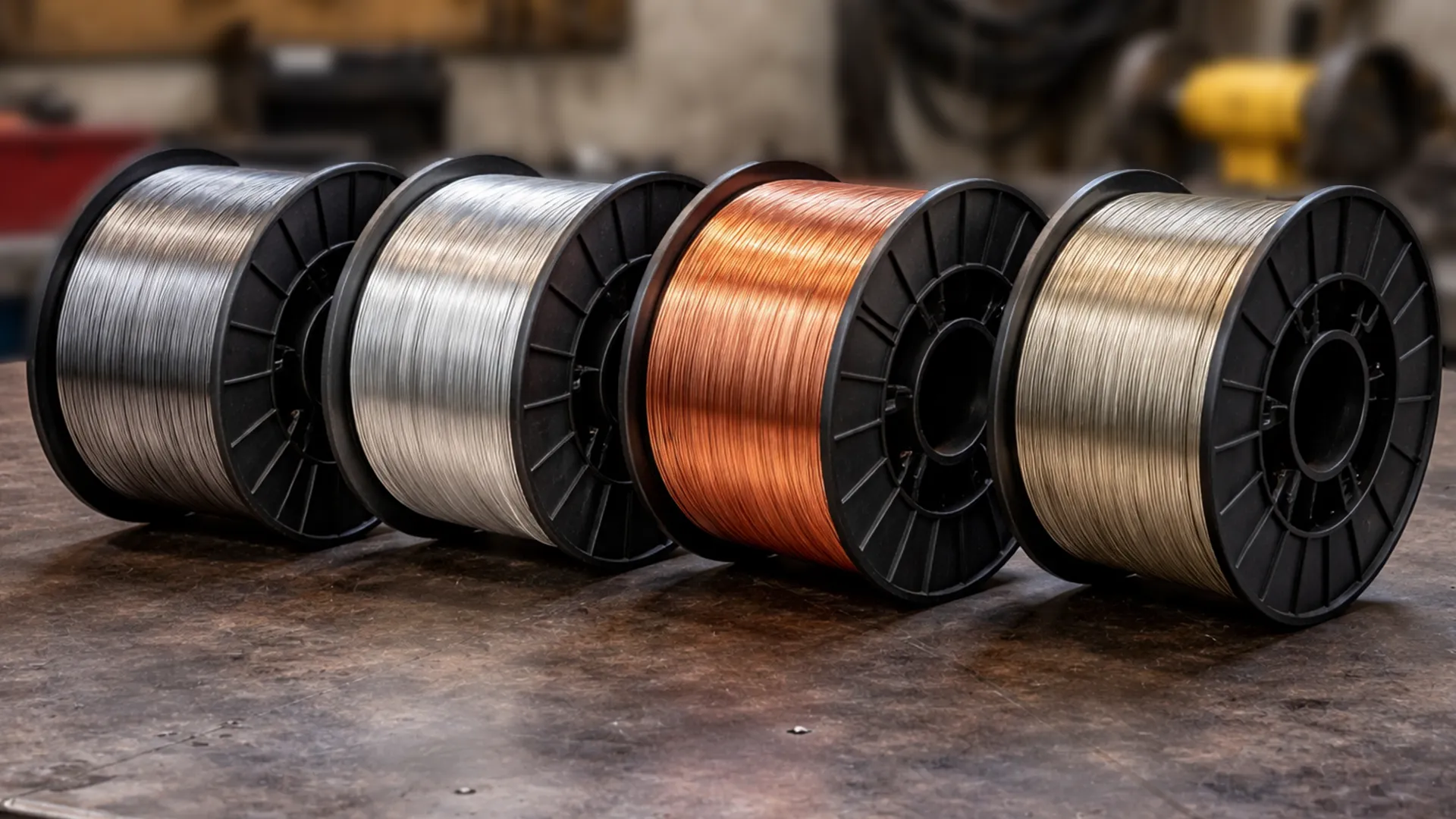
The most common welding wire materials are steel, aluminium, copper, and nickel, each suited to different metals and jobs.
While there are several different metals used for welding wire, the most common ones are steel, aluminium, copper, and nickel.
Steel Welding Wire
Steel welding wire is the most common filler metal used in general fabrication and repair work, especially for mild steel.
A typical example is G3Si1.
It is a copper-coated solid wire used for welding general structural and engineering carbon-manganese steels.
You can use it with mixed shielding gas or with pure CO₂, depending on the job.
Steel wires come with different chemical mixes to suit different needs, such as strength, toughness, crack resistance, or matching the metal you are welding.
Even among mild steel welding wires, the amount of silicon and manganese can change how the arc behaves and how well it handles dirty or imperfect steel.
If you are working to procedures or codes, always check the wire classification and the manufacturer’s datasheet.
It tells you exactly what the wire is meant for and which gases and settings it works best with.
Aluminium Welding Wire
Aluminium welding wire is widely used in fabrication, vehicle repairs, frames, marine work, and infrastructure projects, but it has its own challenges.
Aluminium is softer, so it can be harder to feed. It is also more sensitive to dirt and poor gas coverage.
Even the surface of the wire matters.
Some manufacturing residues can get pressed into the soft aluminium and cause porosity later.
Higher-quality wires are often shaved to reduce this problem.
Cleanliness, steady gas coverage, and a wire feeder set up for soft wire make the difference between good strong welds and problems with porosity.
Copper Welding Wire
Copper-based wires are mainly used for welding copper alloys.
Many welders use them for MIG brazing and joining rather than normal fusion welding.
A common example is CuSi3 (copper-silicon) wire.
It is used for joining and brazing, including welding galvanised sheets and some steel cladding jobs.
Copper-silicon wire lets you use lower heat than regular welding.
This helps when working on thin sheet or coated materials where you want to avoid burn-through or distortion.
The settings and process are different from mild steel MIG, so always follow the manufacturer’s recommendations for gas and parameters.
If you often repair galvanised vehicle panels or thin sheet, copper-silicon wire is one of the most common specialist wires you will come across.
Nickel Welding Wire
Nickel and nickel-alloy wires are used in jobs that need high corrosion resistance, high temperature strength, or joining dissimilar metals.
Many welders mainly use nickel wire for repair work, especially on cast iron.
Nickel consumables are usually classified by their chemical makeup.
For cast iron repair, nickel-iron (NiFe) wire is very common.
It works well for welding cast iron, ductile iron, and for joining cast iron to steel.
It is often used for repairing shafts and other important parts.
Nickel-based wires are more expensive, so they are chosen for specific reasons such as crack resistance, machinability, or matching difficult base metals.
Treat them as specialist wires rather than everyday ones.
Different Welding Wire Diameters
Welding wire diameter affects arc behavior and deposition - smaller sizes suit thin sheet, while larger ones work better on thicker material.
Wire diameter changes how the arc behaves and how much weld metal you can lay down in one go.
It also affects how easy it is to control the weld on thin material.
In everyday MIG work, the most common solid wire sizes are 0.8, 1.0, 1.2, and 1.6 mm.
Flux-cored wires usually start around 1.0 mm, with bigger sizes used as well.
Smaller diameters are easier to control on thin sheet because you can use lower current and keep the weld pool from getting too big.
Larger diameters let you put down more weld metal on thicker sections and are often more efficient for production work.
Using the wrong size can cause issues.
For example, using too small a solid wire on thick material can give you poor penetration and increase the chance of cold laps or lack of fusion, especially if the machine cannot deliver enough amperage.
How to Choose the Right Welding Wire?

Choose the right welding wire by matching it to the base metal, joint type, environment, thickness, and your needs, then test on scrap.
Choosing the right welding wire gets much easier if you follow a simple step-by-step process and base your decision on the actual job instead of just using whatever you usually grab.
Identify the Base Metal and the Joint
Start by looking at what you are welding.
For example, steel, aluminium, cast iron, or galvanised sheet, and what type of joint you need to make, such as a fillet, butt, or lap joint.
This quickly points you toward the right family of wire.
Use steel wire for steel, aluminium wire for aluminium, copper-silicon wire for brazing or joining jobs, and nickel-based wire for specialist repair work.
Decide Based on Environment and Shielding
If you can keep the gas coverage protected, solid wire or metal-cored wire are often the easiest options.
If you are working outside or in windy conditions, self-shielded flux-cored wire is usually the best choice because it makes its own shielding as the flux burns.
Pick Wire Type Based on What You Need Most
Solid Wire
Best for clean work indoors, produces very little slag, and is a good all-round option.
Flux-cored Wire
Handles dirtier steel better, gives strong fusion on the sides of the joint, works well outdoors (especially self-shielded), but you will need to remove slag afterwards.
Metal-cored Wire
Gives low spatter and very little slag, deposits weld metal efficiently, and can help you weld faster and more productively when the job suits it.
Choose Diameter From Thickness and Control Needs
Use the common sizes as a starting point: 0.8 to 1.6 mm for most solid wires, and remember that flux-cored wires usually start around 1.0 mm.
Pick the size that matches the thickness of the material and the position you need to weld in, as well as what your machine can handle.
Do a Short Test and Adjust
Even with the right wire, the settings still matter a lot.
Run a test bead on a scrap piece that has the same thickness and joint setup as your real job.
Check that the arc is steady, the bead looks consistent, and you have acceptable spatter and penetration.
If you are welding thicker steel and struggling to get good fusion, think about whether the wire diameter and your machine’s power are suitable for the job.
FAQ
What is the most commonly used welding wire?
Mild steel wire like G3Si1 is by far the most common, especially for general fabrication and repair work.
When should I use flux-cored wire instead of solid wire?
Use flux-cored wire when welding outside, in windy conditions, or on dirty or rusty steel where solid wire struggles.
Why does wire diameter matter?
Smaller diameters give better control on thin metal, while larger diameters let you lay down more weld metal faster on thicker material.
Do I need special wire for aluminium?
Yes - aluminium wire is softer and more sensitive to dirt and gas coverage, so you need clean metal and the right feeding setup.
How do I pick the right wire for my job?
Start with the base metal, then consider whether you’re indoors or outside, and test a small bead on scrap before starting the real job.
Final Thoughts
Welding wire is a key part of the process that affects weld quality, how fast you can work, and how easy or difficult the job feels overall.
Solid wire is still the standard choice for clean, indoor MIG welding with gas.
Flux-cored wire is the better option for outdoor work and on tougher, dirtier jobs because its built-in shielding and cleaning action can make things much more forgiving.
The material of the wire matters just as much as the type.
Mild-steel wire like G3Si1 handles a huge amount of general fabrication and repair work.
Aluminium wire needs very clean surfaces and good feeding setup.
Copper-silicon wire is great for joining and brazing jobs.
Nickel-based wire is best for specialist repairs such as cast iron.
For more information on welding wire, or help with all your welding needs, get in contact with us here at Xtreme Plasma today.
About the Author
ROB ROSSETTI
Rob Rossetti is the owner, founder, and driving force behind Xtreme Plasma, where he also personally handles technical support and customer care.
After years working as an engineer producing precision components for the oil, gas, and water industries, he founded the business in 2010.
He drew on hands on workshop experience to originally manufacture precision parts before expanding into the in-house design and production of complete CNC plasma tables.
Display prices in:GBP